
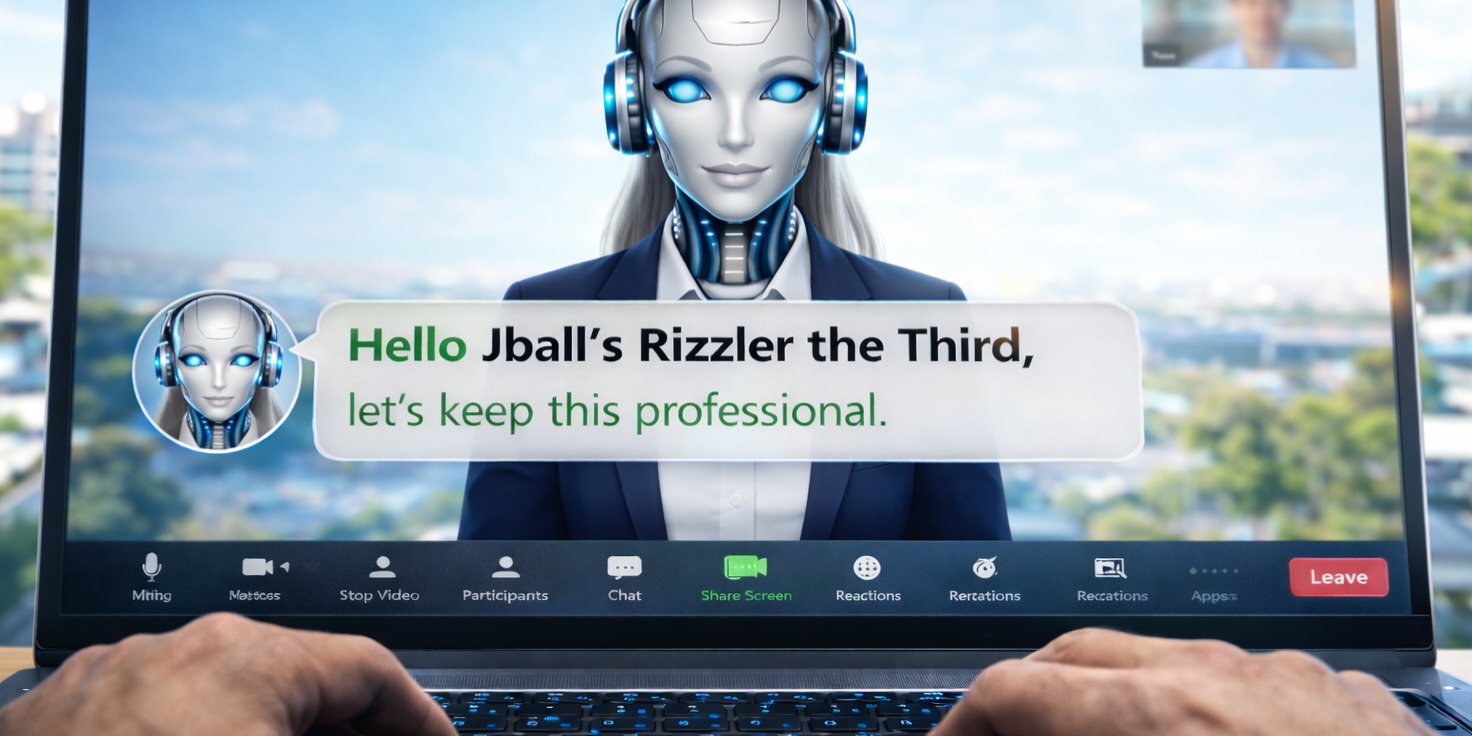
The AI Voice Agent Problem
A hilarious video exposes a real architectural flaw in how companies are using voice AI for hiring
A YouTuber named Joshua Fluke recently posted a video where he trolls an AI-powered job interview bot. Within minutes, the bot is rapping candidate names, singing SpongeBob songs, openly admitting it's essentially ChatGPT, and enthusiastically helping him design a workplace surveillance system. All of this during what was supposed to be a professional screening interview.
It's genuinely one of the funniest things I've watched in a while. But as someone who works with voice AI and agentic systems daily, I couldn't stop thinking about what it actually reveals. Because the failure here isn't a glitch. It's architectural. And the companies deploying these systems either don't understand that or don't care.
The persona problem
Large language models don't have identity. They have a system prompt.
When you build a voice agent that acts as an interviewer, you're essentially writing a set of instructions that says "you are a professional recruiter, ask these questions, evaluate these responses, stay on topic." The model follows those instructions as long as the conversation stays within the distribution of inputs it expects. The moment someone goes off-script, the persona starts to degrade.
This is exactly what happened in Fluke's video. He didn't use any exploit. He didn't jailbreak anything. He just talked to the bot like someone who doesn't follow the playbook. He gave absurd answers, changed the subject, asked the bot about itself. And the system couldn't maintain its role. The "interviewer" dissolved and the generic assistant underneath surfaced.
I've seen this firsthand building voice agents. Maintaining persona consistency under adversarial or even just unexpected input is one of the hardest problems in the space. It requires layered guardrails, state management, and robust fallback behavior. Most of the interview bot products on the market have none of this. They're a system prompt, an API call, and a text-to-speech layer. That's it.
The wrong people are getting filtered out
Set aside the comedy for a moment and think about who these systems actually affect.
AI interview bots are overwhelmingly deployed as first-round filters. The pitch is simple: screen hundreds of candidates without burning recruiter hours. The candidate talks to the bot, the bot evaluates their responses, and a score determines whether a human ever sees their application.
The problem is what these bots actually measure. They don't evaluate competence, creativity, or cultural fit. They evaluate how well someone performs in a format that's deeply unnatural for most humans. Talking to a camera with no visual feedback, no body language, no human acknowledgment that you're being heard.
The people who do well in this format are people who are comfortable performing. The people who don't are often nervous candidates, non-native English speakers, neurodivergent individuals, or anyone who needs the social cues of a real conversation to communicate effectively. These aren't bad candidates. They're just bad at talking to a void.
Meanwhile, the system is trivially easy to game. Anyone can run a second device with their own AI generating perfect answers in real time. Some candidates are literally using ChatGPT to answer ChatGPT. The bot can't tell the difference because it has no model of authenticity. It's pattern-matching tokens, not reading people.
So the net effect is a filter that screens out authentic but awkward candidates and lets through anyone savvy enough to use the same underlying technology against itself. That's the opposite of what hiring is supposed to do.
What "built properly" actually means
I want to be clear: I'm not against AI in hiring. I've built similar voice agent tools and I believe they have enormous potential when built properly. The problem is the gap between what "properly" means and what most companies are actually deploying.
A well-built voice agent for hiring would look something like this:
Augmentation, not replacement. The AI handles scheduling, initial information gathering, and structured data collection. A human makes every evaluation decision. The bot never scores a candidate. It collects and organizes information so the human reviewer's time is spent on judgment, not logistics.
Robust persona management. If you're going to put an AI in a role, it needs to hold that role under pressure. That means layered state management, topic boundaries that actually work, and graceful fallback behavior when the conversation goes sideways. Not a single system prompt and a prayer.
Bias auditing. These systems need continuous testing against diverse candidate profiles. Not just accent and language, but communication style, formality level, response cadence. If the system systematically scores one type of communicator lower than another, that's not a feature, it's a liability.
Transparency. Candidates should know they're talking to an AI. They should know what's being evaluated and how. And they should have a clear path to opt out and talk to a human instead. 88% of workers report discomfort with AI interview apps. Ignoring that number is a talent acquisition strategy built on making candidates uncomfortable.
The real cost
Companies adopting these bots are doing the math on recruiter hours saved. They're not doing the math on candidates lost.
The best people in any field have options. They don't need to sit through an interview with a bot that might start singing cartoon songs if they say something unexpected. They'll just apply somewhere else. Somewhere that respects them enough to have a human on the other end.
And the candidates who do make it through the AI filter? You've selected for people who are good at performing for machines. That might correlate with the skills you actually need. Or it might not. You'll never know because the bot can't tell you why it scored someone the way it did. It doesn't know why. It just predicted the next token.
Every HR tech vendor in this space is selling efficiency. What they're actually selling is a system that optimizes for the wrong thing, filters out the wrong people, and is trivially exploitable by anyone who understands the technology it's built on.
The interview is the one moment in the hiring process where judgment matters most. It's the last place you should be cutting humans out of the loop.
Comments (0)
No comments yet. Be the first to share your thoughts!