
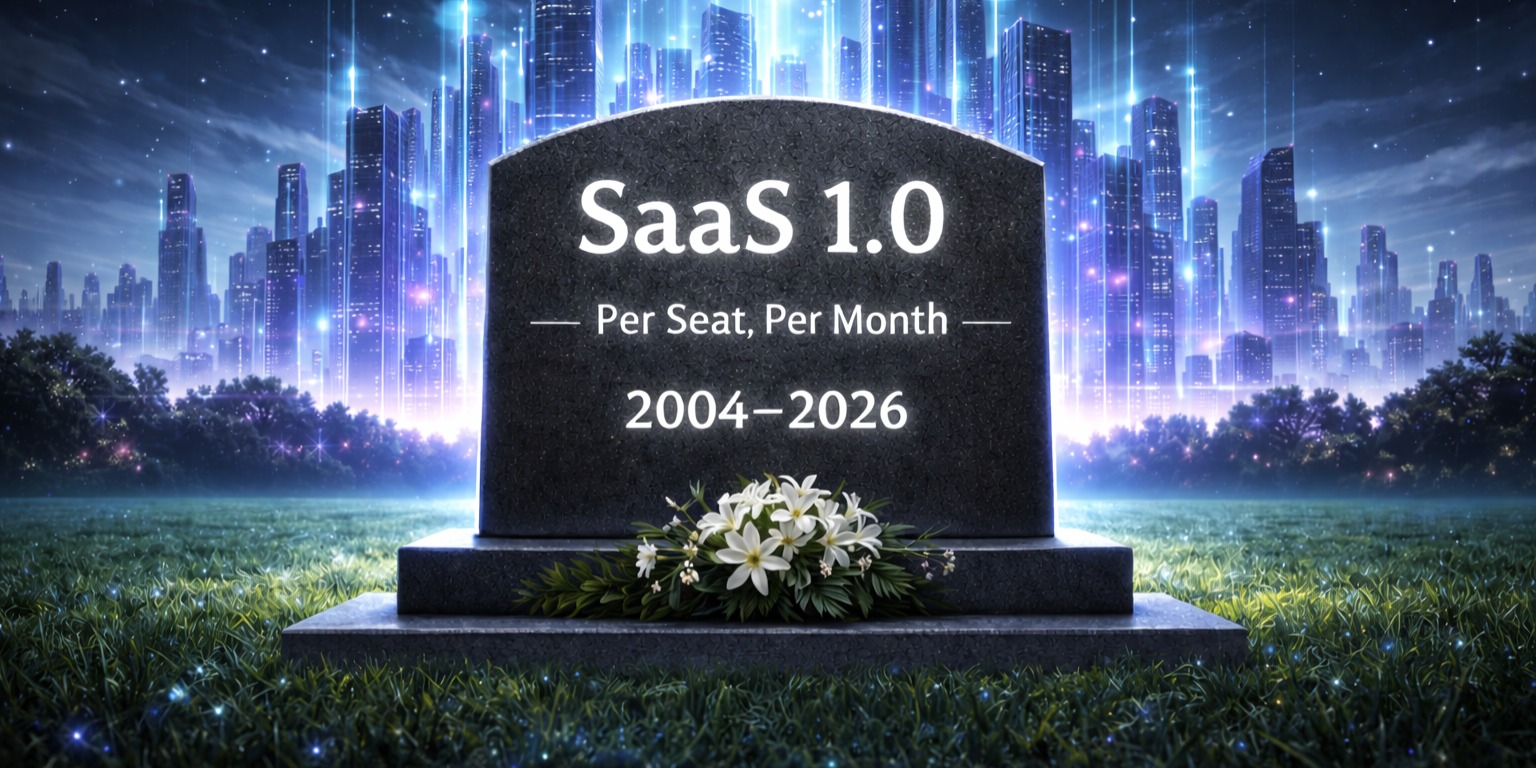
SaaS is dead! Long live SaaS!
The acronym hasn't changed. The meaning has.
For twenty years, SaaS meant Software as a Service. You paid per seat, per month, for access to someone else's tool. Salesforce. Zendesk. HubSpot. Jira. The model was simple: we host the software, you bring the humans, everybody pays by headcount. The entire industry, worth over $300 billion today, was built on the assumption that software is a tool and humans do the work. That assumption is about to collapse.
Software as a Service is becoming Service as a Software
I've been thinking about this shift for a while, and I think the framing matters. SaaS 1.0 sold you a tool. SaaS 2.0 sells you the outcome. The software doesn't just assist your team anymore. It replaces the function your team was performing.
Not a chatbot. Not a copilot. An autonomous system that takes a business problem in and delivers a business result out. Customer service ticket comes in, gets resolved, customer is satisfied, no human touched it. Lead comes in from marketing, gets qualified, gets routed, gets a personalized outreach sequence, books a meeting. Finance close process runs itself at month-end. Procurement evaluates vendors, negotiates terms, flags anomalies.
The "S" in SaaS used to stand for Software. Now it stands for Service. And the service is being delivered by software.
Zendesk already sees the writing on the wall
If you want to understand how real this shift is, look at what Zendesk is doing.
Last year, Zendesk launched what they call the Resolution Platform. The pricing model is outcome-based: instead of charging per seat, they charge per resolution. You pay when the AI fully resolves a customer issue without a human getting involved. If the AI can't handle it and escalates, your don't pay.
Think about what that means. The vendor is no longer selling access to a dashboard. They're selling a completed task. A resolved ticket. An outcome. And they're confident enough in their AI agents' ability to handle the work autonomously that they'll stake their revenue on it.
They also offer a "Dynamic Pricing Plan" that lets enterprise customers reallocate budget between human agent seats and automated resolutions as their AI adoption scales. They're literally building the pricing mechanism for companies to gradually swap humans for agents.
This isn't a beta feature buried in a settings menu. This is their go-to-market strategy for the next decade. They are pivoting their entire business model from "pay for the tool your agents use" to "pay for the job getting done."
The architecture of replacement
Here's what the actual technology looks like, because this isn't theoretical.
Modern agent swarms use what's called an autonomous orchestration layer. You don't build one AI agent that handles everything. You build a swarm of specialized agents, each good at a narrow task, and an orchestrator that coordinates them, routes work, handles exceptions, and learns from outcomes.
A customer service swarm might have an intent classifier, a knowledge retrieval agent, a policy compliance checker, a tone analyst, a resolution agent, and a quality verification agent. They work together on every interaction. The orchestrator decides which agents engage, in what order, and whether the issue can be fully resolved or needs a human.
Zendesk's architecture does exactly this. They have a multi-agent system where specialized agents identify customer needs, retrieve relevant knowledge, verify compliance, and drive toward resolution. An LLM verifies the accuracy of the resolution before it gets counted as "automated." They're targeting 80% automation rates.
This is not a chatbot with a better personality. This is a system that replaces the function of a customer service department.
And customer service is just the obvious starting point. I've seen the same architecture applied to sales development and procurement workflows. Financial close processes. Legal document review. Anywhere the work can be decomposed into specialized tasks and measured by whether the job actually got done.
The per-seat model is already dying
Gartner predicts 70% of businesses will prefer usage-based or outcome-based pricing over per-seat models by 2026. They also predict 40% of enterprise SaaS solutions will incorporate outcome-based pricing elements by the same year.
The math is straightforward once you see it. If an AI agent swarm can handle 80% of your customer support volume, you don't need 80% of your support agents. If you don't need 80% of your support agents, you don't need 80% of your Zendesk seats. The per-seat vendor's revenue just dropped 80% while the customer's support quality stayed the same or improved.
No SaaS company can survive that math with a seat-based model. The only way to maintain revenue is to shift from charging for human access to the tool to charging for the work the tool autonomously performs. Zendesk figured this out. Others are scrambling.
My prediction: five years to pivot or die
I'm going to be blunt with a prediction I think will age well.
Any SaaS company that is not actively pivoting to an outcome-based, service-delivery model powered by autonomous agents will be out of business within five years. Not struggling. Not "in decline." Out of business.
The economics are brutal for anyone standing still. Right now, a company paying $150/seat/month for 50 customer service agents is spending $7,500/month. Under Zendesk's resolution model, they'd pay $1.50 per resolution and handle the same volume for a fraction of that. Once one vendor offers that deal, every customer in the market starts asking their current vendor why they're still paying by the seat.
Incumbents clinging to seat-based pricing are going to watch their addressable market shrink in real-time. Every agent a customer automates away is a seat that vanishes from the contract. Revenue doesn't plateau. It contracts. And it contracts at the exact moment the company needs to pour money into AI capabilities to remain competitive. That's not a downturn. That's a trap with no exit.
Microsoft is already building AI sales agents that handle lead research, meeting scheduling, and closing low-complexity deals. Salesforce built an entire marketplace for AI agents designed to replace employees across functions. Amazon is building autonomous agents for AWS customer operations. These aren't experiments. These are core product strategies from companies that correctly read where this is going.
The mid-tier SaaS companies that are still debating whether to add a chatbot to their product are bringing a knife to a gunfight that already started.
SaaS 2.0 is about outcomes
The way I see it, the next era of SaaS comes down to a simple principle: the customer pays for the outcome, not the access.
SaaS 1.0: "Here's a tool. Bring your own team. Pay per head."
SaaS 2.0: "Tell us the outcome you want. Our agents will deliver it. Pay per result."
The whole model flips. The vendor isn't providing software to enable human work. The vendor is doing the work, using software, and selling you the completed service. Service as a Software. SaaS, but reversed.
Zendesk rebuilt their pricing around resolutions. Salesforce is reframing around digital labor. Microsoft is positioning agents as "the new apps." Intercom shipped an AI agent called Fin and started charging per resolution instead of per seat. These companies get it.
Meanwhile, a lot of mid-market SaaS vendors are still talking about "AI-powered features" and "intelligent automation" as bullet points in their marketing copy. They're adding AI as an enhancement to the existing model instead of recognizing that AI is the model. That gap in understanding is going to be the difference between survival and irrelevance.
What this really means
The SaaS industry spent two decades convincing companies to move their workflows into cloud software. That worked. $300 billion worth of it worked. But cloud software always pointed toward automation, and automation always pointed toward removing the human from the loop. We just didn't have the AI to close that gap until now.
SaaS 1.0 digitized work. SaaS 2.0 eliminates it.
I keep coming back to a simple idea: the real product was never the software. It was the outcome the software made possible. Once AI can deliver that outcome without a human in the middle, the tool becomes irrelevant and only the outcome matters.
Five years from now, the SaaS landscape is going to look nothing like it does today. Some of today's biggest names will have transformed into something unrecognizable. Others will be gone. And the ones who saw it coming but chose to wait for more data will have the most painful stories to tell.
Comments (0)
No comments yet. Be the first to share your thoughts!