
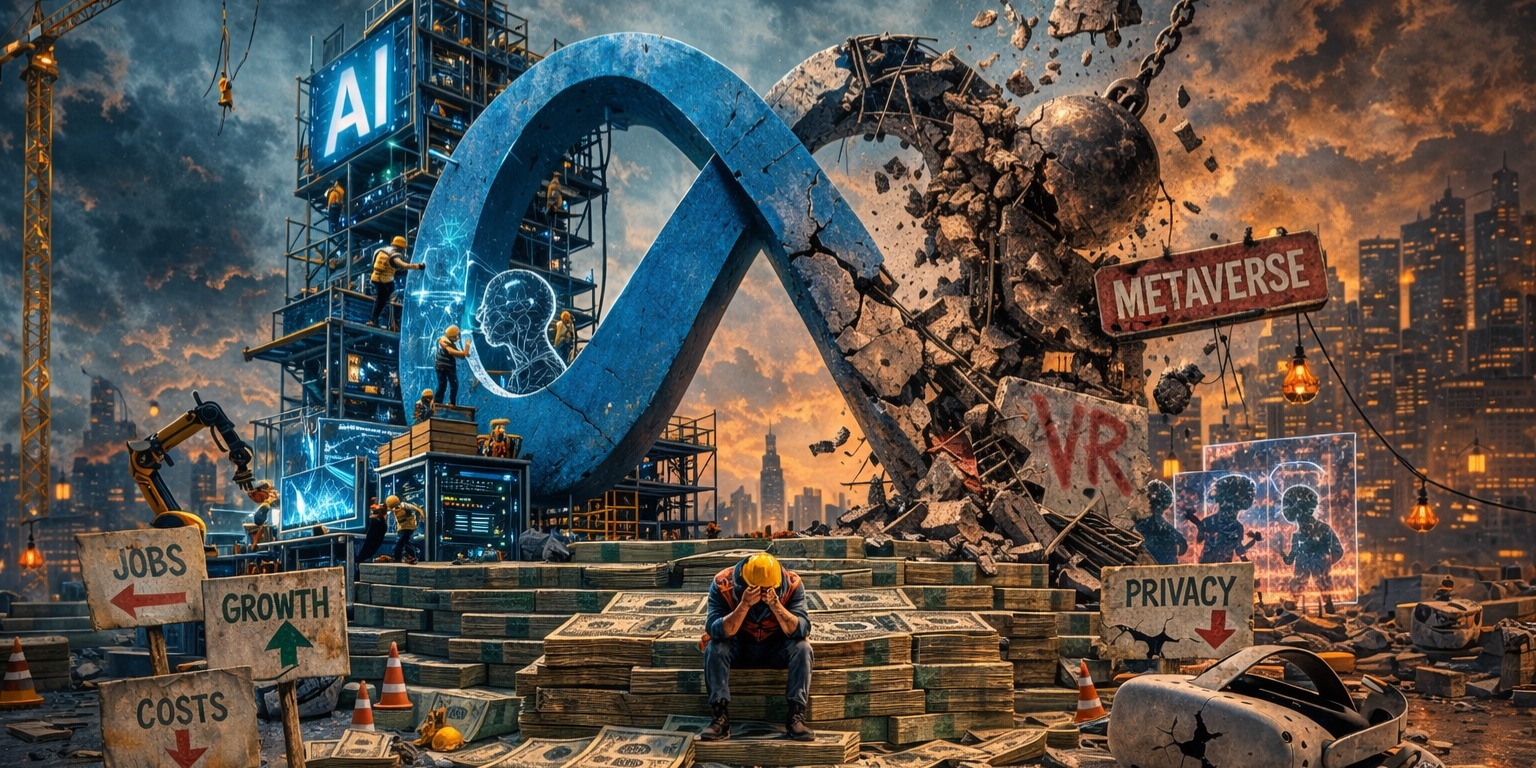
Meta isn't cutting 16,000 jobs because of AI. It's cutting them because of the Metaverse.
How the biggest layoff of 2026 became the most predictable one — and why the 'AI restructuring' story is a cover for something much simpler
Last week, Atlassian cut 1,600 people. I wrote about that one. The CTO was gone. 900 of the cuts came from R&D. The official line was 'rebalancing for the AI era.' I argued the real story was a product problem: Jira had become something nobody liked using, and AI was making it easy to build alternatives. The layoffs were the symptom. The product was the disease.
Now Meta is reportedly deliberating cuts of up to 20% of its global workforce. 16,000 people out of roughly 79,000. And the framing is, once again, 'AI restructuring.'
I don't think the Atlassian playbook applies here. Meta's problem isn't a product problem. It's simpler and uglier than that. Meta overhired during the pandemic, incinerated tens of billions on a bet that didn't pay off, and now needs to fund an even bigger bet. The 16,000 people are the price of entry.
The $600 billion pivot
To understand why Meta wants to cut 20% of its staff, you have to understand the scale of what Zuckerberg is trying to build next.
Meta has committed to spending up to $600 billion on AI infrastructure by 2028. That includes gigawatt-scale data centers, custom silicon, and the physical backbone to train and serve foundational AI models at a scale that competes with Google, OpenAI, and Anthropic. The 2026 capital expenditure alone is projected at $135 billion. On top of that, Meta has been acquiring AI startups like Manus and Moltbook, and offering astronomical compensation packages to recruit elite ML researchers. Reports suggest some of these packages are in the tens of millions per person.
This is not incremental investment. This is a company betting its future on a completely different technology stack than the one it was built on. And pivots of this magnitude have to be funded by something.
Meta's ad business is healthy. Revenue has been growing. But $135 billion in capex in a single year doesn't materialize from operating cash flow alone, especially when stockholders are already nervous about margins. The math requires aggressive cost reduction elsewhere. Headcount is the biggest controllable cost at any tech company. If you want to free up tens of billions, you start there.
Which brings us to the official explanation.
Zuckerberg's 'one talented person' theory
In internal communications and public statements, Zuckerberg has been framing the cuts around a specific idea: that projects which once required large teams can now be completed by a single, highly talented person using AI tools. Meta is reportedly establishing new AI engineering units with manager-to-employee ratios of up to 1:50. The message is clear — AI has made individual contributors so productive that the company simply doesn't need as many people.
I'm not going to pretend this is entirely wrong. I've spent two years building agentic AI workflows at Zendesk, and I've watched a team of five deliver output that used to require twenty or more. AI does make small, skilled teams dramatically more capable. That part is real and I've lived it.
But there's a difference between 'AI enables smaller, better teams' and 'AI is why we're firing 16,000 people right now, in March 2026.' The first is a genuine technological shift that plays out over years. The second is a capital allocation decision that needs a narrative.
Look at who's actually being cut and the picture gets clearer.
Follow the cuts, not the press release
When you examine the reported targets, the 'AI made these people redundant' story starts to thin out.
Reality Labs. This is the division that posted operating losses exceeding $15 billion in 2023 alone. The cumulative losses since Meta's metaverse pivot are staggering. The company is now pivoting away from fully immersive VR toward AI-powered wearables and smart glasses. Cutting Reality Labs staff isn't an AI efficiency move. It's an admission that the metaverse bet failed, or at minimum that it failed in the form Zuckerberg originally envisioned. Those jobs aren't being automated. The project they supported is being abandoned.
Middle management. Zuckerberg added layers of management during the hypergrowth years. Between 2019 and 2022, Meta's headcount nearly doubled, from around 45,000 to over 86,000. That kind of expansion creates organizational bloat almost by definition. Flattening the org chart now, under the banner of the 'Year of Efficiency,' is really just unwinding the hiring decisions of 2020 and 2021. This is a correction, not a transformation.
HR, recruiting, and admin. These functions scale with headcount. If you're cutting 16,000 roles, you need fewer people to recruit, onboard, and administer a smaller workforce. This is a downstream effect, not an AI capability.
Content moderation. This is the one area where the AI explanation holds some weight. AI moderation tools have genuinely improved, and Meta has been shifting toward automated content moderation for years. But content moderators were already among the lowest-paid, most precariously employed people at the company. Many were contractors. Replacing them with AI agents is real, but it's not the story of 16,000 layoffs. It's a rounding error in a much bigger restructuring.
Legacy engineering and broad AI research. Reports say Meta is shifting away from fundamental AI research toward applied, high-stakes foundational models — their 'Avocado' and 'Mango' projects. This is a strategic refocus, not automation. They're not replacing researchers with AI. They're replacing one research agenda with another and firing the people who were working on the old one.
Add it up and what you get isn't a workforce displaced by artificial intelligence. It's a workforce displaced by a failed strategy (metaverse), pandemic overhiring (middle management and support functions), and a capital-intensive pivot (foundational AI) that requires aggressive cost reduction to fund.
The playbook is public now
Meta is not the first company to do this. It won't be the last. But the pattern has become so consistent that it's worth naming explicitly.
Jack Dorsey cut 40% of Block's workforce — roughly 4,000 people — and told the market it was about AI-driven efficiency. Block's stock surged 24%. What actually happened: Block had ballooned from 3,800 to over 13,000 employees during the pandemic. The stock had already fallen 75% from its peak. The layoffs brought headcount back to 2020 levels. Employees publicly said the AI tools couldn't actually do the jobs of the people who were let go.
Amazon attributed 16,000 corporate cuts to AI. On earnings calls, where executives face legal liability for misleading investors, Andy Jassy walked it back. The cuts were 'cultural' — driven by failed return-to-office mandates that didn't produce enough voluntary attrition to trim the pandemic workforce.
In New York State, companies conducting mass layoffs are required to file WARN Act notices. The forms include a penalty-free checkbox where employers can indicate whether the layoff was caused by automation. Out of 160 major companies that filed these notices in the most recent reporting period, zero checked the box. On a legal document, the AI story disappears.
The pattern: tell investors it's AI, tell regulators it's restructuring, collect the stock bump.
Sam Altman, of all people, has started calling this out. He's used the term 'AI-washing' — companies using AI as a convenient, market-friendly excuse to cover up for pandemic overhiring or poor management. When the CEO of OpenAI is saying the AI layoff narrative is overblown, maybe we should listen.
The damage that fear does
Here's where I stop being clinical about this, because the human cost of the narrative is real, whether the narrative itself is true or not.
Computer science enrollment dropped 8% in the 2025-2026 academic year. Students are looking at the headlines and concluding that a CS degree is a dead end. That's a generation of talent making career decisions based on a story that is, at best, heavily exaggerated.
Glassdoor's most recent index showed tech worker confidence suffering the largest year-over-year drop of any industry. People are anxious, demoralized, and scared. Research from the American Economic Journal has shown that the mere threat of automation suppresses wages — you don't actually have to automate anything. Workers who believe their jobs are at risk accept lower pay, tolerate worse conditions, and stop pushing back.
Workers are currently 12% less likely to reject job offers than they were a few years ago. That's not because AI made their skills less valuable. It's because the narrative made them afraid to negotiate.
Goldman Sachs projects that AI displacement could add 0.5 to 2.4 percentage points to global unemployment during the transition period. But the actual shape of the transition is subtler than mass layoffs. It's teams that stop growing. Roles that never get backfilled. Headcount plans that shrink quietly in next year's budget. Not because anyone got fired, but because the work is getting done with fewer people. The IMF's Kristalina Georgieva called AI a 'tsunami' hitting the global labor market, but the wave isn't crashing all at once. It's the tide going out slowly.
The fear, though — FOBO, fear of becoming obsolete — that hits immediately. And it hits everyone, regardless of whether their specific job is actually at risk.
The uncomfortable middle ground
I keep coming back to the same tension I wrote about after the Atlassian cuts. The corporate narrative about these layoffs is dishonest. But the underlying technology is real.
Meta is not firing 16,000 people because AI made them obsolete. It's firing them because the metaverse burned $50 billion, the pandemic hiring binge created a bloated org, and Zuckerberg needs to fund a $600 billion infrastructure buildout. AI is the press release. Capital reallocation is the spreadsheet.
But AI genuinely does make small, skilled teams wildly more capable. I've seen it. I've built it. The five people on my team running AI-augmented workflows produce what used to take departments. That shift is real, and pretending it won't eventually reshape how companies think about headcount is a different kind of dishonesty.
The problem is that these two truths are getting collapsed into one story. 'AI is replacing everyone' is simple, dramatic, and wrong. 'AI makes teams more productive, and some companies are using that narrative to cover up financial mismanagement' is complicated, boring, and accurate.
The people who lose in both scenarios are the same: workers who freeze. Who stop learning. Who let FOBO convince them that the game is already over.
It's not. Learn the tools. Build with them. The people who actually understand AI aren't the ones getting cut in these restructurings. They're the ones Meta is paying tens of millions to recruit.
The layoff press release is for Wall Street. Your career decisions shouldn't be based on it.
Comments (0)
No comments yet. Be the first to share your thoughts!