
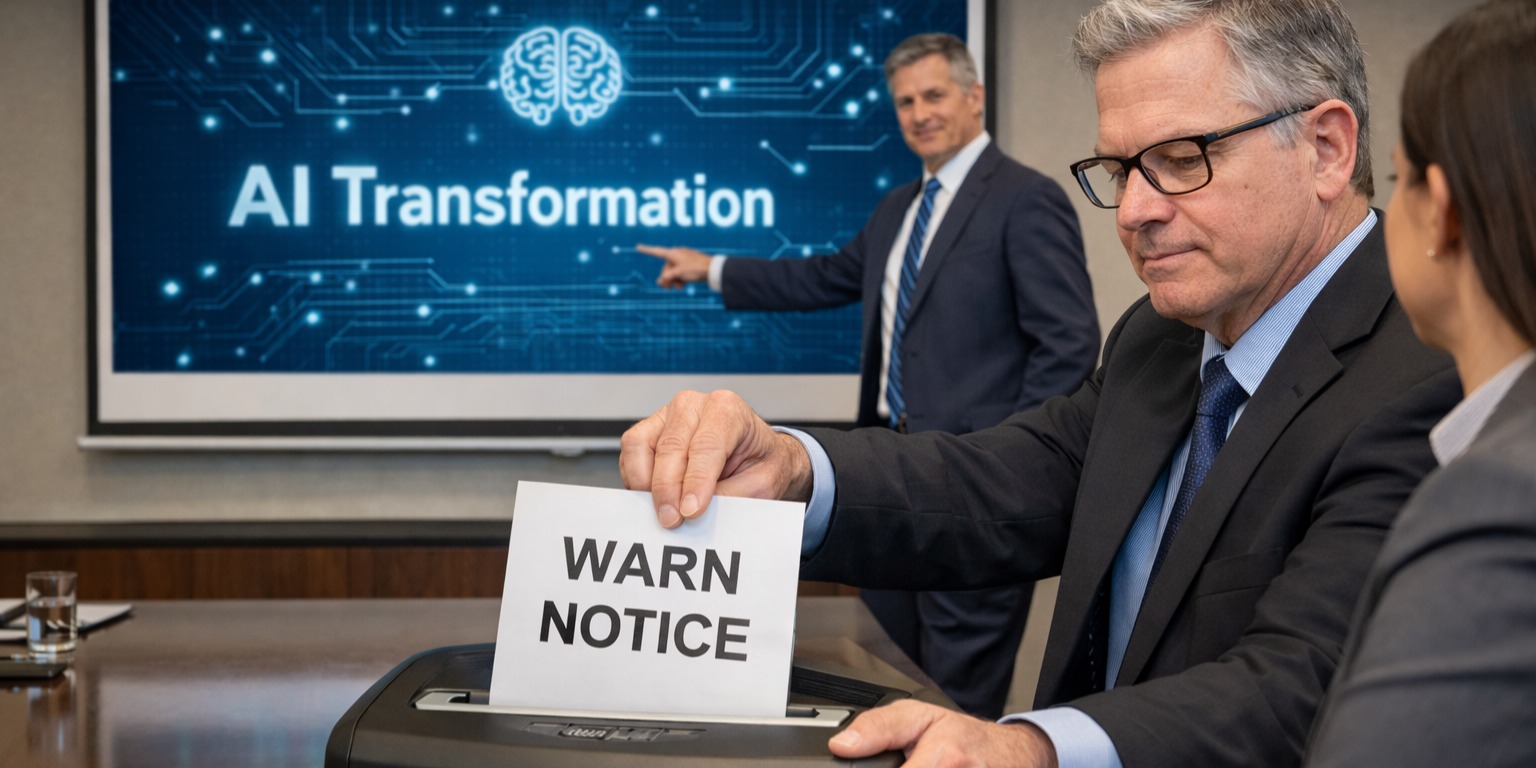
FOBO is a product, not a side effect!
How the AI layoffs narrative became corporate America's most profitable lie — and why the real shift is something nobody's talking about
There's a new acronym circulating in workforce psychology circles: FOBO. Fear of Becoming Obsolete. According to a recent global talent report, employee fear of losing their job to AI jumped to 40% in a single year. Worker thriving rates dropped lower than they were during peak COVID. Behavioral data shows people are currently 12% less likely to reject job offers than they were just a few years ago.
That last number is the one that should keep you up at night. Not because AI is actually replacing everyone, but because the fear that it might is doing exactly what it's designed to do.
Research from the American Economic Journal has demonstrated that actual automation is not required to suppress wages. The mere threat of automation is sufficient. If workers believe their jobs are at risk, they accept lower pay, tolerate worse conditions, and stop pushing back. Every CEO in America has access to that research. And the current AI narrative is handing them a weapon they didn't even have to build.
The data tells a very different story
If AI were truly behind the wave of corporate layoffs, you'd expect companies to say so when it matters. They don't.
In New York State, companies conducting mass layoffs are required to file WARN Act notices with the government. These forms include a voluntary, penalty-free checkbox where employers can indicate whether the layoff was caused by "technological innovation or automation." Out of 160 major companies that filed these notices in the most recent reporting period, including companies that had publicly told shareholders and the media about their AI-driven transformations, zero checked the box.
Not a single one.
When the audience shifts from investors to regulators, the AI narrative evaporates. On a legal document, nobody wants to claim AI caused anything.
The national numbers tell the same story. Data from Challenger, Gray & Christmas for early 2026 shows over 108,000 job cuts, the worst since 2009. Only 7% cited AI. For the entirety of 2025, AI was cited in only 4.5% of layoffs. The actual drivers were the same mundane corporate realities they've always been: contract losses, market conditions, cost restructuring, and the long-overdue correction from pandemic-era hiring binges.
The overhiring cover-up
The pandemic created a hiring bubble that nobody wants to own publicly. Between 2020 and 2022, cheap capital and digital demand spikes caused tech companies to massively expand headcount. When the economy normalized and stock prices corrected, those same companies needed to cut. The problem is that telling investors "we hired too many people and now we need to fix it" gets you punished. Telling them "AI changed everything" gets you rewarded.
Jack Dorsey cut 40% of Block's workforce, roughly 4,000 people, and explicitly blamed AI tools for changing how companies operate. The market celebrated. Block's stock surged 24%. But the reality was straightforward: Block had ballooned from 3,800 to over 13,000 employees during the pandemic. The layoffs brought the company back to 2020 headcount levels after a five-year, 75% stock decline. Employees said the AI couldn't actually do the jobs of the people who were let go.
Amazon publicly attributed 30,000 corporate cuts to AI. But on earnings calls, where executives face legal liability for misleading investors, CEO Andy Jassy walked the claim back. He admitted the cuts were "cultural," driven by failed return-to-office mandates that didn't produce enough voluntary resignations to trim the bloated pandemic workforce.
The pattern is consistent: public narrative says AI, legal filings say something else entirely.
Manufactured panic as financial strategy
The AI fear narrative isn't just useful for HR departments. It's been weaponized by financial markets.
Earlier this year, a viral Substack paper titled the "2008 Global Intelligence Crisis" triggered a massive market sell-off. Written as a fictional memo from two years in the future, it described an "intelligence displacement spiral" where companies would adopt AI, lay off workers, boost margins, beat earnings, reinvest in more AI, and repeat. The concept of "Ghost GDP," economic output that shows up in national statistics but doesn't circulate because server farms don't pay mortgages, was compelling enough to move markets.
Here's what most people didn't know: the co-author was the managing partner of a $262 million hedge fund. Public financial filings showed his fund was actively shorting the exact tech stocks the paper predicted would crash. After the sell-off, the authorship was quietly edited to downplay his involvement. Legendary investor Michael Burry amplified the panic to his followers while his own fund held nearly a billion dollars in put options against major tech companies.
The short-sellers made $24 billion in paper gains in five weeks. The panic wasn't organic. It was strategy.
So where does that leave us?
Here's where I have to be honest, because my own experience complicates the clean "it's all a scam" conclusion.
I've spent the last two years building AI-powered agentic workflows for enterprise planning at Zendesk. I've designed systems that automate strategic planning cycles, portfolio management processes, and operational workflows. I've empowered my team to use AI in ways that fundamentally changed what we can accomplish.
And I can tell you with complete certainty: a 5-person team running AI-augmented processes can now deliver what used to require 20-30 people. My team is at least 10x more efficient than we were 18 months ago. Entire planning cycles that used to consume weeks of calendar time now take hours.
The corporate narrative about current layoffs is a lie. But the underlying capability shift is very, very real.
The disconnect is timing and honesty. CEOs are claiming AI replaced workers today to cover up decisions they made three years ago. That's the scam. But the technology genuinely does make small teams dramatically more capable, and pretending that won't eventually reshape how companies think about headcount is just a different kind of denial.
The real restructuring won't look like layoffs
A 2026 paper by three leading economists, including two Nobel laureates, examined AI's actual economic trajectory and rejected both the doomsday and the "everything is fine" narratives. Their conclusion: AI has the mechanical capacity to either displace workers or empower them. Which path we take is a choice, not an inevitability.
But here's what I see happening on the ground, and it's subtler than either camp admits.
The real shift won't look like mass layoffs announced in press releases. It will look like teams that stop growing. Roles that never get backfilled after someone leaves. Departments that run leaner year over year because the people who stayed learned to use AI as a force multiplier. Hiring freezes that never thaw. Headcount plans that quietly shrink in the next budget cycle, not because anyone got fired, but because the work is getting done with fewer people.
The tragedy the economists identified is that tech firms currently see higher immediate financial returns in replacing workers than in empowering them. And because the public has bought into the narrative that mass displacement is inevitable, nobody is demanding the alternative. The fear narrative becomes a self-fulfilling prophecy.
What this means for you
FOBO is real, but the correct response isn't paralysis. It's adaptation.
The people at risk aren't the ones currently employed. They're the ones who would have been hired next. The roles that would have been created. The teams that would have expanded. AI isn't eliminating existing positions nearly as fast as the headlines suggest. It's eliminating the need for new ones.
If you're working today and you learn to use AI effectively, you become more valuable, not less. You become the person who can run a function that used to need a department. The person whose output makes additional hiring unnecessary. That's not a threat to your job. It's leverage.
But if you buy into FOBO and let it freeze you, if you stop developing, stop experimenting, stop learning the tools, then when the quiet restructuring does come, you're exactly in the position the fear narrative was designed to put you in: grateful for what you have, unwilling to demand more, and easy to leave behind.
The CEOs selling the AI layoff story are running a con. But the technology underneath it is real. The answer isn't to ignore either fact. It's to refuse to be the one who benefits them both.
Comments (0)
No comments yet. Be the first to share your thoughts!