
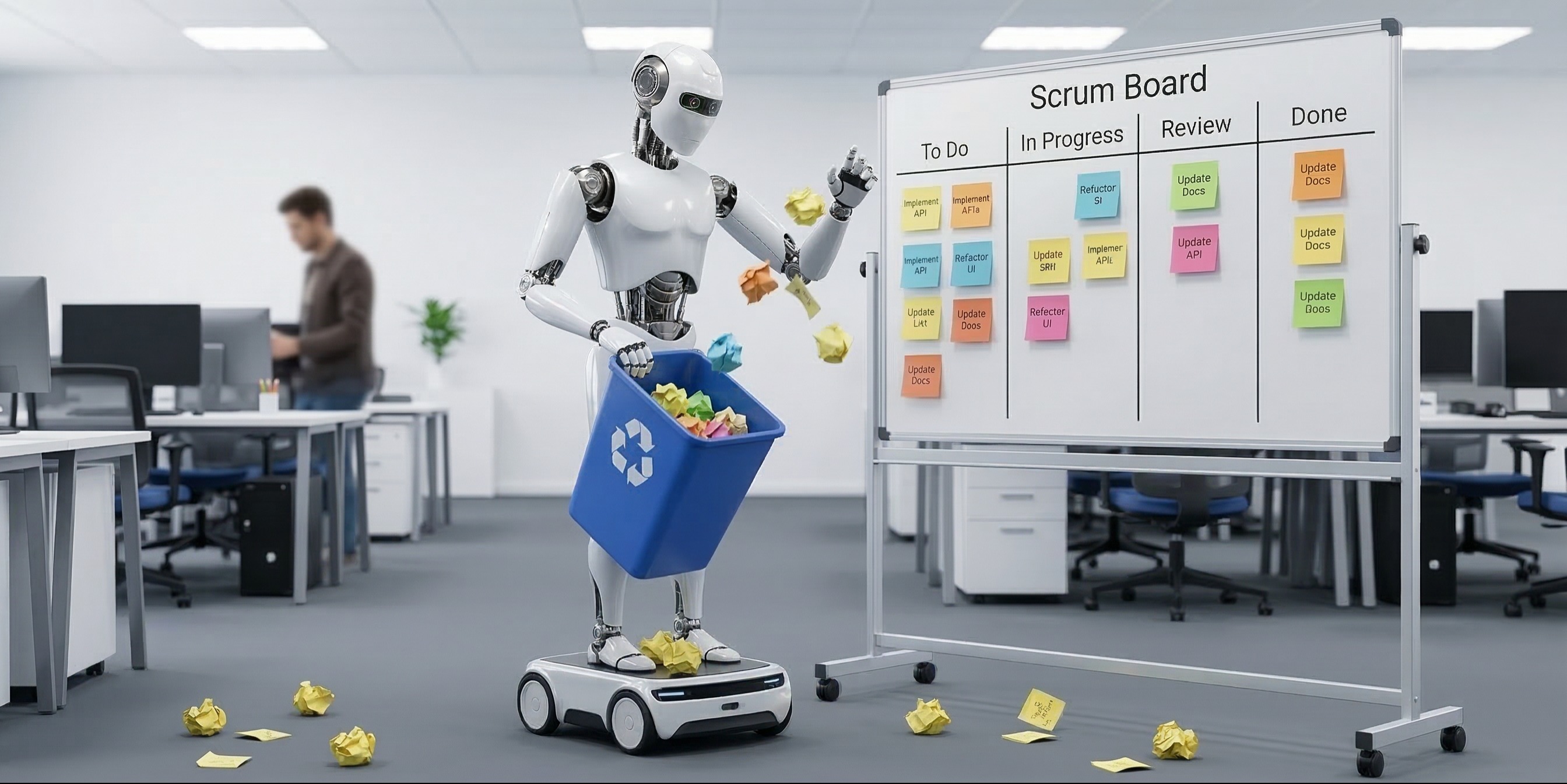
AI killed Agile. And nobody cares.
Developers spend 8 to 17 hours a week in meetings. A 2-week sprint burns nearly 25% of its capacity on ceremony before anyone writes a line of code. Under half of all software developers spend more than 20 hours a week actually being productive.
Ron Jeffries co-created story points. He now publicly calls them a "bloody mistake." Ken Schwaber co-created Scrum. He calls the obsession with velocity "waste."
These are the people who built the system, and they're watching it eat itself.
It started on a napkin
The Agile Manifesto was four values and twelve principles on a single webpage. That's the whole thing. You can read it in two minutes.
Scrum, when Schwaber and Sutherland first published the Scrum Guide in 2010, was 16 pages. Sixteen pages to run a software team. Roles, events, artifacts, done. It was clean, it was practical, and it worked.
Then the consultants showed up.
The "enterprise agile transformation" market is now worth $42 billion. Scrum Alliance and Scrum.org have minted over 2 million certifications between them. SAFe alone has trained over a million people. There are Certified Scrum Masters, Professional Scrum Masters Level I through III, SAFe Agilists, SAFe Program Consultants, SAFe Lean Portfolio Managers, Release Train Engineers. Dozens of methodologists built entire careers selling courses about how to run a standup correctly.
The original Agile values are still sound. Working software over comprehensive documentation. Responding to change over following a plan. Nobody argues with those. The problem is what grew around them: a certification economy, a consulting industry, and a management layer that exists primarily to perpetuate itself.
The Jira problem
If this sounds familiar, it should. It's the exact same arc that Jira followed.
Jira started as a bug tracker. Simple, useful, did one thing well. Then it became the agile board, the service desk, the portfolio tracker, the product discovery tool. Each feature made sense individually. Together they created something nobody actually enjoys using but everyone is stuck with because the switching costs are too high.
Agile-as-practiced went through the same process. The standup started as a quick sync. It became a status report. Sprint planning started as a conversation about priorities. It became a 4-hour estimation theater. Retrospectives started as honest feedback. They became HR-safe venting sessions that change nothing structurally.
The methodology that was supposed to eliminate waste became full of it. The framework that was supposed to be lightweight became a heavy organizational dependency. And in both cases, the bloat was driven by the same force: an ecosystem of vendors, consultants, and administrators whose livelihoods depended on the thing getting more complicated, not less.
And now AI is eating both of them
Capital One cut 1,100 dedicated agile roles in January 2024. Wells Fargo laid off 45 Scrum Masters in early 2025. These aren't random cuts. Companies are looking at roles whose primary output is facilitating process and asking what, exactly, they're paying for.
At the same time, 92% of developers now use AI coding tools. GitHub Copilot has 20 million users across 90% of Fortune 100 companies. About 41% of all code in production workflows is AI-generated. Engineers using these tools complete tasks 55% faster.
A prompt-to-merge cycle takes 15 to 30 minutes. Agents refactor hundreds of files overnight. Tests get generated. Documentation gets synthesized. The sprint was a compromise for human speed, and that speed constraint is disappearing.
When the work completes in an afternoon, you don't plan it in two-week cycles. You don't estimate it in story points. You don't hold a retrospective about it. The entire scheduling apparatus was built for a production speed that no longer applies.
What actually matters now
The question Agile was built to answer was: who is doing what, and how much did they get done?
The question that matters now: what context does the agent operate in, and what guardrails prevent it from breaking things at 3 AM?
This is the shift from managing people to managing systems. The architecture matters more than the schedule. The constraints matter more than the estimates. The automated validation pipeline matters more than the sprint review. A Jira board cannot answer these questions. Story points cannot answer them. A standup definitely cannot.
The metrics change too. Not velocity, which was always just a proxy for effort that got gamed into meaninglessness, but throughput, architectural alignment, rework ratio, error rate. The measurement shifts from "how busy are the humans" to "how coherent is the system."
The uncomfortable question
If your organization removed daily standups, sprint planning, retrospectives, and story points tomorrow, would your product stop shipping?
I already know the answer for most teams. It would ship faster, because you'd recover a quarter of your engineering capacity that's currently consumed by talking about shipping.
Agile isn't being replaced by another methodology. There's no new certification to buy. No coach to hire. No $42 billion industry waiting in the wings. The shift is structural: from executor to architect, from task manager to system thinker, from measuring human effort to measuring system coherence.
The Agile Manifesto was right. What the industry built on top of it was a racket. And the machine doesn't care about your ceremony.
Comments (0)
No comments yet. Be the first to share your thoughts!